By Gowher Bhat
There’s a kind of man who doesn’t need to announce his presence. You don’t see him on podiums, and his name rarely appears in headlines. He won’t interrupt a conversation, let alone command a crowd. And yet, if you were to trace the quiet veins of compassion that pulse through a place, you’d likely find him at their heart.
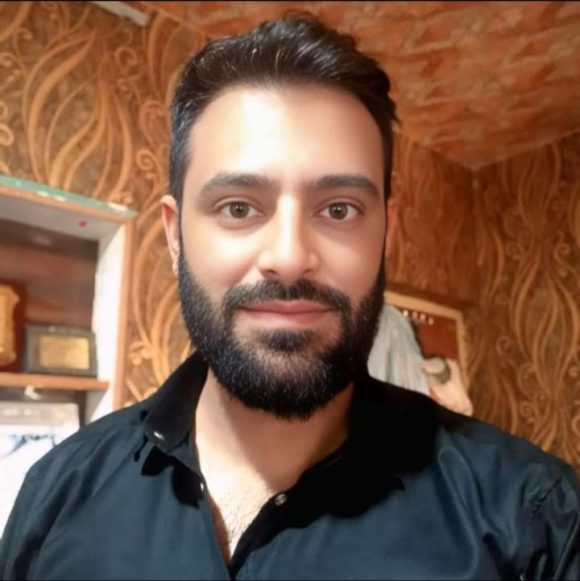
In Pulwama, that man is Gamgeen Majeed.
He doesn’t wear a badge. He doesn’t quote speeches. And yet, when someone needs a ride to the hospital, when a blood bank sends out a late-night request, or when a neighbour needs someone to listen as he’s already on his way. He doesn’t do it because he must. He does it because, for him, there is no other way.
In a time when kindness is often curated and shared online, Gamgeen’s way of living feels rare. It’s a quiet, unadvertised generosity. A way of being that seeks no witness. It is the opposite of performance as it is presence.
Gamgeen Majeed is from Pingalgam, a modest village in South Kashmir. If you ever pass through, you might notice the walnut trees, or the scent of burning wood curling up from small homes. You might see the narrow road that winds quietly through the landscape, lined with aging willows and old stories.
It’s not the kind of place you read about in books. But it’s the kind of place where lives like his are made humble, rooted, unwavering.
Gamgeen has spent decades doing what many people only dream of: living in service to others. He’s never been part of an NGO. He has no titles. There are no newspaper features with his name in bold. And yet, people remember him. Not for what he owns or says, but for the space he holds in the lives of others.
He has mopped hospital floors after storms, held hands in silence when words would only fail, and stood vigil in hospital corridors while doctors worked inside. His acts are not scripted. They are not fuelled by ambition. They arise, quietly and surely, like spring after a hard winter.
Perhaps the only visible trail of his quiet mission lies in the numbers: 207 pints of blood donated over the course of his lifetime. That number is staggering but not just for what it means physiologically, but for what it says about the man behind it.
But even numbers fail to tell the full story. Gamgeen didn’t walk into hospitals only when it was convenient. He answered calls in the middle of the night. He trekked in snow to reach clinics. He gave blood before breakfast. He often waited in hospital lobbies without being asked — just in case someone might need him.
He once said, softly and without ceremony:
“My blood is the least I can give. If it keeps someone breathing, that’s enough reward for me.”
There’s no fundraising banner that can capture that kind of thinking. No award can quite do it justice. Because his belief isn’t in acts of charity. It’s in human continuity — in being part of the thread that keeps another person alive, even if just barely.
From LD Hospital in Srinagar to the dust-covered wards of small rural clinics, Gamgeen’s blood has likely flowed through hundreds of lives. Children. Elders. Strangers. People he never met and never will. That’s the thing about quiet heroes: they don’t trace their impact. They simply live it.
It would be easy to call Gamgeen a saint or a hero. But doing so might miss the point. What makes his story remarkable is not grand achievement but his belief in small, repeatable, often unseen acts of goodness.
He visits patients he doesn’t know. He buys fruit for old men sitting alone in hospital lawns. He once stood for hours outside a labour ward because a nurse had mentioned they might need help if a donor didn’t show up. No one called him. He just showed up anyway.
There’s a term in philosophy — “ethics of care.” It speaks to a form of moral life cantered not on rules, but on relationships. It’s about showing up. Again, and again. Even when no one’s watching. Even when no one says thank you.
You might wonder where this kind of spirit comes from. Some say it’s upbringing. Others say it’s temperament. Maybe it’s both. But perhaps it’s also born from quiet observation from watching elders serve without speech, or mothers feed neighbours before eating themselves.
In the old ways of village life, compassion wasn’t taught. It was modelled. It was lived. You saw it when your uncle lent a hand to fix someone’s roof. You saw it when your grandmother lit an extra oil lamp — not for herself, but for the family next door.
It’s tempting to imagine that service comes only in certain shapes: doctors, social workers, teachers. But Gamgeen reminds us that you don’t need a role to make a difference. You don’t need an organization to help someone. You only need willingness and the courage to act.
Over the years, he’s become a sort of myth in the region — not because of anything he’s done to earn it, but precisely because he hasn’t tried to. His story spreads in whispers. A nurse tells a new recruit. A mother tells her son. A shopkeeper shakes his head in admiration when recounting how Gamgeen showed up one snowy evening, carrying warm tea and blankets for a patient’s family stuck outside.
He doesn’t knock. He doesn’t wait for praise. He just walks in, offers help, and leaves. Sometimes without even saying goodbye.
In a world where we’re often overwhelmed by scale — global problems such as climate change, mental health issues, deforestation — a man like Gamgeen is a kind of anchor. He reminds us that you don’t have to change the world to matter. You only have to show up for the person in front of you.
He reminds us that kindness doesn’t need to be viral. It needs to be real.
He reminds us that integrity doesn’t require recognition. It only requires consistency.
And perhaps, most of all, he reminds us that the greatest legacies are not built through declarations but through deeds.
We spend so much of our lives chasing light — chasing visibility, acknowledgment, a moment in the sun. But maybe the real task is not to find the light, but to let it fall where it belongs.
Because in every village, in every small place tucked away from the maps, there lives someone like him — someone who teaches, simply by living, showing that kindness doesn’t need permission.
It only needs practice.
.
Gowher Bhat is an author, columnist, freelance journalist, book reviewer, and educator from Kashmir. His work explores the human condition with depth and sincerity. He believes in the quiet power of words to inspire change and compassion.
.
PLEASE NOTE: ARTICLES CAN ONLY BE REPRODUCED IN OTHER SITES WITH DUE ACKNOWLEDGEMENT TO BORDERLESS JOURNAL
Click here to access the Borderless anthology, Monalisa No Longer Smiles
Click here to access Monalisa No Longer Smiles on Kindle Amazon International
 Borderless