By Snigdha Agrawal
He is at the door at 10 am on a Sunday. Sleepy eyed. But all smiles. A small frame for a twelve-year-old. Neatly dressed in jeans and a t-shirt, sneakers on his feet, a size too big. I presume he must have risen early to accompany his parents to their workplace. A well brought-up lad, as is obvious from his body language, and impeccable manners. So, unlike other kids I cross in the lift daily, studying in private schools where the annual fees runs into six digits.
“Good morning, Ma’am,” he says, leaning against the door, while I hand out the laundered clothes for ironing. I start counting the clothes. He beats me to it. One…two…three, right up to twenty-seven. Bent on his knees he folds the clothes methodically and bundles them in the faded bedsheet, kept specifically for this purpose. Heaving the bundle on his shoulder, he leaves, assuring the clothes will be ironed and returned by the evening. Once again repeating the number twenty-seven and the cost of ironing per piece at Rs.7/-, making it obvious, that he is aware of the prevailing rates. Homework done well. I see him off at the service lift, with many such bundles picked up from other apartments, piled into a trolley, crudely fashioned after luggage trolleys bellboys use in hotels for moving visitor luggage from floor to floor.
It sets me thinking. Is he ironing the clothes himself? It can’t be. How could he ever lift that heavy charcoal iron box[1]? And if so, does that make it grossly wrong and unacceptable — surmounting to child labour…?
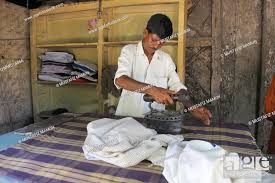

I went to the basement of our apartment complex to search for the designated space allocated to the ‘ironing persons’. Rent-free with power points, rarely used. Comfortable with the traditional method. I find him sitting on a plastic stool, jotting down the number of clothes against the apartment number and the amount payable. That puts my fears to rest.
At the workstation, Manorama, his mother, is busy preparing for the day’s ironing. A makeshift ironing board of plywood sheets, salvaged from throwaway pieces, assembled to resemble a cabinet, with a tabletop and storage below. Where was Bhaskar, I asked. The little guy is quick to respond. “Sundays… my mother and I take over from my father. All week, he is busy from 8 am to 8 pm, returning home tired, and ready to hit the bed.”
I was touched, to say the least. Here was a caring twelve-year-old boy who was helping out his parents on a Sunday. Collecting and delivering clothes from apartments, doing the book-keeping without any complaints. Leaning against the wall, are his school books. Presumably to catch up on weekend assignments. To my question “Do you like reading?” his face lights up like a thousand-watt bulb. His smile with a few missing teeth, stretches from ear to ear. Okay…that solved a problem I needed to deal with. I decided to surprise him with books that were lying in the house, keepsakes from my childhood. Time to part with them.
Around 7 pm, he arrives with my bundle, unknots the bedsheet, opening the four folds and proceeds to count the clothes, for his satisfaction and mine. I can hear his sigh of relief. Numbers match. Contents are the same as was handed over. He is surprised as I hand over the books. “These are for you to read…I’m sure you will understand and enjoy the stories. If you don’t, come over whenever you have spare time. I’ll explain.” The smile on his face is priceless.
“So, Mahesh what did your mother cook for breakfast and lunch today?” I ask, worried about his nutritional needs.
I see the look of confusion on his face, wondering why this old lady was asking so many questions. Pauses. He seems to be churning something over in his mind and then says, “Sundays I make breakfast and allow my parents to sleep longer. Today I made lemon poha[2] and filter coffee. Amma made curd rice for lunch.” I was moved enough to want to give him a big hug. Not sure, how he would respond to getting physical, instead gave him a bag of candies. He was hesitant to accept it, till I pushed it into his little hands. His pupils dilated and the spark in his eyes said the unsaid. Admittedly, I was curious. I needed to engage him in conversation to know more about his plans for the future.
To my question, “Do you plan to take over your father’s trade once you are of age?” Pat is his emphatic reply: “No…Ma’am! I am working hard to secure the qualifying marks for admission into an engineering college to study Computer Science and work in an office. My parents are saving for my education. Part of the earnings from ‘ironing clothes’ are kept aside for this purpose. That is why I help out on Sundays and school vacations.”
“What happens to your father’s business then?”
“Oh! It has been agreed that it will be discontinued, once I can provide for them. Another ten years. My grandfather passed away early because of the occupational hazards associated with this profession. I don’t want my parents to meet the same fate. They deserve a better life.” That tears me up. So much wisdom in that little head.
.
[1] In India, there are people who make a living of ironing clothes for the more affluent. They normally use heavy charcoal irons and not electric irons… they could set up a stall under a porch or under a tree…
[2] flattened rice with spices/ flavouring
Snigdha Agrawal (nee Banerjee) is a published author of four books and a regular contributor to anthologies published in India and overseas. A septuagenarian, she writes in all genres of poetry, prose, short stories and travelogues.
PLEASE NOTE: ARTICLES CAN ONLY BE REPRODUCED IN OTHER SITES WITH DUE ACKNOWLEDGEMENT TO BORDERLESS JOURNAL
Click here to access the Borderless anthology, Monalisa No Longer Smiles
Click here to access Monalisa No Longer Smiles on Amazon International
 Borderless