Book review by Anita Balakrishnan
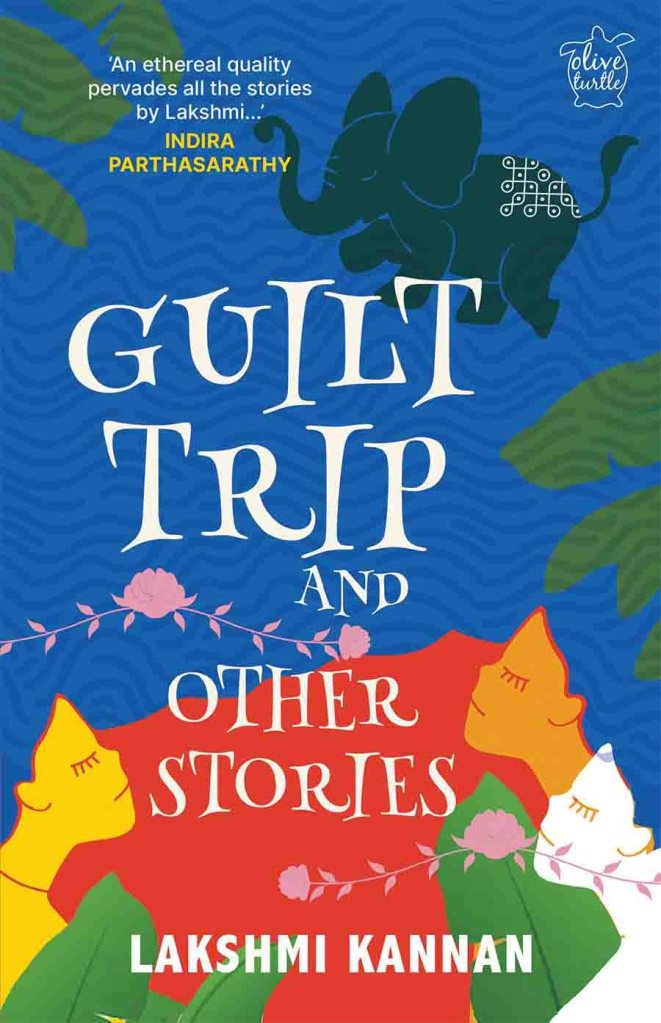
Title: Guilt Trip and Other Stories
Author: Lakshmi Kannan
Publisher: Niyogi Books
The short story distills within its succinct form a moment from the amorphous flow of life experiences and re-presents it with a crystalline clarity. A reader cannot help but be transformed by this epiphanic moment as it serves to illuminate some of life’s most baffling ambiguities. Lakshmi Kannan’s latest book of short stories, Guilt Trip and Other Stories, published in 2023, includes thirteen such stories that provide an insight into the lives of people navigating the vicissitudes of life.
In a similar vein, the entry on Lakshmi Kannan in the Routledge Encyclopedia of Indian Writing in English, Eds Manju Jaidka and Tej N. Dhar (2023), observes that her short stories “are explorations of lived experience that create an apocalyptic dimension. They pitch the reader between the luminal space of the living and the dead”.
Several writers have commented on the exacting nature of the short story form, as it denies writers the space to develop their themes or trace the arc of their characters’ lives, its taut boundaries requiring every word to be justified. Given the number of women indulging in practising this genre and attaining great acclaim, it has been suggested that the short story is particularly suited for women’s subjects, the preoccupation with domestic life and the vagaries of human relationships. It is thought that the inflexible limits of the form serve as a restraint on elaborate descriptions of the sprawl of family life, condensing them to into chiselled vignettes that allow gleaming insights to shine.
Lakshmi Kannan, a virtuoso of the short story, has published twenty-eight books, including collections of poetry, novels in both English and Tamil and translations. She is a bilingual writer who writes in Tamil under the penname Kaaveri. She is a prolific writer whose recent books include a historical novel The Glass Bead Curtain (2020, c2016), an English translation of Tamil writer T. Janakiraman’s acclaimed novel The Wooden Cow (2021) and a collection of poetry Sipping the Jasmine Moon (2019).
This collection Guilt Trip and Other Stories contains eleven short stories and two longer stories, ‘Janaki turns a Blind Eye’ and ‘VRS’. Although pan-Indian in nature, Lakshmi Kannan’s stories are able to effortlessly showcase the ineffable flavour of Tamil culture. Her protagonists are frequently educated women, who struggle to reconcile their desire to be treated as equals within their families, dealing with the cultural mores that seek to restrict them to their homes and kitchens. The varied themes of Lakshmi Kannan’s stories include the spiritual awareness of the transience of human life as seen in the story ‘Open the Gate’. Another story that evokes spiritual transcendence is ‘Floating Free’, where a grieving daughter is comforted by a hummingbird which she sees as the reincarnated spirit of her mother.
A recurring trope among the stories is the equating of women with food and cooking, a reflection of the way women are often perceived in Indian society. Lakshmi Kannan elaborates on this idea observing that in the Tamil cultural milieu the regressive rural-urban divide continues as the norm. Several people, particularly men, do not have a progressive outlook even when they interact with contemporary women who are successful professionals. The author notes: “In Tamil Nadu, the retrograde maxim that a ‘woman’s place is in the kitchen and backyard’ still functions with a mind-numbing attitude irrespective of her economic, social or professional status”. The author employs this trope in the stories ‘Dregs’, ‘Kitchen Fire’, ‘The Colour Green’ and ‘Ladies Watch’. The latter two stories also delineate an allied theme, the insensitivity of adult children in the diaspora who do not hesitate to use their aging parents as unpaid domestic help. Another food related subtext that Lakshmi Kannan introduces is the selfishness of men who demand that the women serve them plenty of food, yet callously consume it without caring to check if there is enough for the women and children of the household.
Nevertheless, the author does not fall into the trap of essentialising Indian men as selfish, uncaring boors. In the story ‘As Dapper as the Come’ she turns the notion of a well-dressed, attractive man being arrogant and self-obsessed on its head. The dapper young man lends a ready helping hand to an older couple in distress unmindful of sullying his expensive suit. Furthermore, in the charming story ‘A for Apple’, the author explores the delight that a small-town boy from Karnataka takes in the rhythms and sonic vibrations of his vernacular, Kannada.
It is perhaps in narrating the strength of the bonds formed among women who use them to circumvent or subvert the rigid hierarchies and oppressively restrictive customs that govern traditional families that Lakshmi Kannan is at her most impressive. She explores the corrosive jealousies, subterfuges and pettiness that undermine relationships within a family. The long story ‘Janaki turns a Blind Eye’ is replete with irony. Narrated in five sections, the story relates how a nearly blind matriarch Janaki helps a young bride defeat the machinations of the senior members of the family who are plotting to steal her jewellery and silverware. ‘Addigai’ and ‘Annapurna Bhavan’ are two stories where the interaction between women may be set in counterpoint.
In the former, a grandmother furtively bequeaths an heirloom necklace on her granddaughter, warning her never to wear it at family celebrations. When Priya, the granddaughter, wears it just once several years later to a family wedding, she is rudely interrogated by the hostess as to how she came by it. The acquisitiveness and jealousy within this affluent family is in stark contrast to the warm camaraderie that characterizes the bonds between women in a small middle-class eatery in the story ‘Annapurna Bhavan’. The well-to-do narrator insists on eating at the same eatery as her driver where she is assailed by the aromas of the food she had earlier eaten in her childhood. The unabashed enjoyment of their food by the women at the eatery, their friendly banter, their freedom from family constraints and their closeness exhilarates the narrator.
Yet it is not just Lakshmi Kannan’s significant themes — the refusal to be bound by narrow definitions of womanhood, the flowering of the creative impulse, a child’s playful linguistic experiments, the conflicts between appearance and reality – that make her work stand out. It is her prose that evokes both the asymmetries and passions in everyday life with a poetic intensity that is remarkable. An acutely observant chronicler of the incongruities, the asymmetries, the felicities and the marvellous absurdities of life, Lakshmi Kannan is able to express it with precision, empathy and humour. She has an innate sensitivity to the jealousies, treasons, duplicities, compromises, evasions, tender feelings and sentimentalities that characterise human relationships.
Lakshmi Kannan’s stories highlight the extraordinary within the quotidian, revealing the layering of the concrete and the mysterious, the interweaving of diverse elements that reveal that nothing is ever as it seems on the surface. She shows us that even the most ordinary individual has hidden facets that can never be completely known. It is her treatment of the special bonds that can be forged among individuals and contradictory nature of human relationships that makes Lakshmi Kannan’s fiction so special.
.
Dr Anita Balakrishnan is the author of Transforming Spirit of Indian Women Writers published in 2012. She is a contributor to the Routledge Encyclopaedia of Postcolonial Studies edited by Sangeetha Ray and Henry Schwarz.
Email ID: shalkri@gmail.com
PLEASE NOTE: ARTICLES CAN ONLY BE REPRODUCED IN OTHER SITES WITH DUE ACKNOWLEDGEMENT TO BORDERLESS JOURNAL
Click here to access the Borderless anthology, Monalisa No Longer Smiles
Click here to access Monalisa No Longer Smiles on Kindle Amazon International
 Borderless